
A while back, most of my work as a product manager started the same way.
You’ve got a rough idea in your head — something about a problem, maybe something a stakeholder has said like:
“We need to improve renewals.”
I’ve heard that a lot — especially working in travel insurance. On the surface, it sounds straightforward.
Improve renewals → improve retention.
But if you’ve done this job for a while, you know that’s not really where you start. And that’s usually the moment where the blank page hits. It usually starts with a messy thought and in one case, the ask was exactly that:
“Let’s improve renewal rates for travel insurance customers.”
You could jump straight into optimising renewal comms but instinct tells you to step back. Because renewals are an outcome, not the starting point.
So the real thought becomes:
“Are customers even having a good enough experience before we get to renewal?”
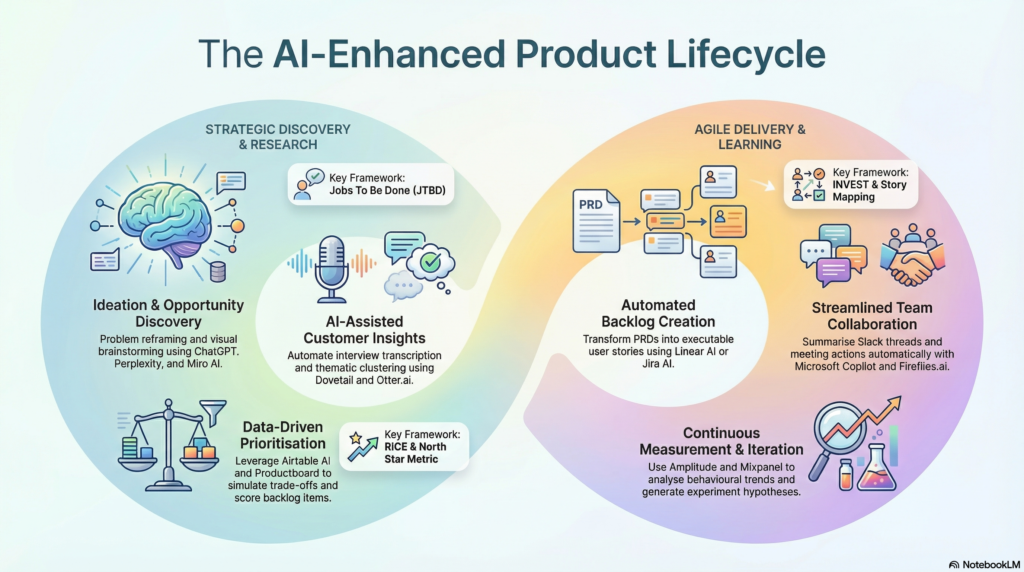
This is where one can bring AI in early — usually something flexible like ChatGPT or even Perplexity you’d want a bit more grounding in real-world signals.
You could ask:
“If renewal rates are low in travel insurance, what upstream journey issues might be causing that?”
And within a few seconds, you’ve got a spread of possibilities:
- Poor onboarding
- Lack of engagement
- Low perceived value
Nothing revolutionary — but it gets you moving.
Instead of sitting with a blank page, you’re already shaping the problem. Then you start pulling in real-world signals where things get messy again.
You’re looking at:
- Customer complaints
- Call centre logs
- Partner feedback
- Analytics
I’ve seen this play out before — even when working on the mobile app at Centrica for British Gas.
There, the ask wasn’t renewals — it was:
“We need to improve the app and make it simple for customers to understand their bills.”
In this stage, there are loads of tools you could use — things like Dovetail or Otter
are strong if you’re working heavily with interviews and transcripts.
But even just using ChatGPT to say:
“Group these insights into themes and highlight the biggest pain points”
…gets you to something usable quickly.
You start to see patterns:
- Customers don’t understand their bill cycles
- They don’t fully understand the product
- Interaction only happens when something breaks
That clarity comes much faster than it used to. Somewhere along the way, it becomes a decision
Now you’ve got options:
- Fix the billing information
- Improve lifecycle engagement
- Optimise renewal comms
But you can’t do all of it.
In the travel insurance example, the real question becomes:
“Do we fix the end of the journey, or everything leading up to it?”
This is where AI becomes more of a thinking partner.
We could ask:
“What are the risks if we focus only on renewal optimisation?”
Or even use something more structured in tools like Coda AI or Airtable AI
to start sketching out prioritisation models.
Again, not relying on it for the answer — just using it to pressure-test thinking.
It helps you move from:
“This feels right”
to “I’ve thought this through properly”
Then comes the part where things need to become real. This is where strategy turns into actual work.
Let’s say the decision is:
“We need to improve engagement across the policy lifecycle”
Now you need to translate that into something a team can build.
User stories. Acceptance criteria. Edge cases.
This is where AI tools become very tangible.
There are a few you could use here, but something like
Linear AI is a strong example when it comes to backlog management — especially for turning rough ideas into structured tickets.
I’ll start with something like:
“Customers don’t engage with their policy after purchase — create user stories to improve engagement.”
And you get:
- Draft stories
- Acceptance criteria
- Ideas you might not have considered
You still refine it — but you’re not starting from scratch. That’s the difference.
Delivery used to feel heavier than it needed to be. Whether it was travel insurance or something like the British Gas app, delivery always comes with overhead.
Meetings. Updates. Alignment.
There are loads of tools in this space now — things like
Microsoft Copilot or Fireflies are good examples — mainly because they just take care of the background work.
Meetings get summarised
Actions get pulled out
Decisions are easier to track
It’s not transformational in isolation. But over time, it removes a lot of friction.
Then you get to the bit everyone cares about — did it actually work?
Back to the original problem: renewals.
Let’s say you’ve:
- Improved onboarding
- Added engagement touchpoints
- Tried to build more perceived value
Now you’re watching the numbers.
And something doesn’t move the way you expected.
Instead of just staring at dashboards, I’ll use AI alongside analytics tools like
Amplitude or Mixpanel
and ask:
“What are possible reasons this hasn’t improved?”
You get hypotheses:
- Engagement isn’t meaningful
- Pricing still a blocker
- Wrong timing of comms
It doesn’t replace analysis — but it gives you a direction.
So what’s actually changed?
The work itself hasn’t changed.
Whether it was:
Travel insurance journeys
Or a blank canvas app at British Gas
The core job is still:
- Understand the problem
- Make decisions
- Deliver outcomes
What’s changed is how you move through it and using the right Ai tools at the right time, they remove the friction between each step.
The biggest difference I’ve noticed isn’t that AI makes you instantly better. It just makes everything a bit smoother.
You don’t get stuck at the start. You don’t spend as long structuring things. You don’t lose time on the heavy lifting.
And in a role where momentum matters, that’s everything.
Because over time, those small gains compound.
And you just end up operating at a completely different pace.